 |

Presented here are countermeasures
to apply when spray guns are not functioning well.

| While the countermeasures described here apply to nearly all
spray guns, there might be some models to which they do not.
For details, please refer to the instruction manuals provided
for each model. (These manuals are uploaded in PDF format
on the page on which spray guns are featured.) |
|
 |
Spray gun does not emit liquid |
 |
| If air pressure is low,
the necessary pressure for piston operation might not be reached. |
| |
Please raise air pressure to
the prescribed level (0.2MPa ~ 0.3MPa, depending on the model).
If the piping is narrow and substantially extended, pressure
loss will occur. Thus, even if the intention is to provide
0.3MPa, actual pressure could fall to under 0.2MPa by the
time it reaches the gun. Even if the solenoid valve's orifice
is small, similar pressure loss will occur. If several spray
guns are being used and only some of them will not emit liquid,
the narrowness of the original piping is often the cause.
If liquid is emitted at first but then fails to be emitted
after a while, it is conceivable that compressor horsepower
is too low. |
| Incorrect piping connection |
| |
Have the connections for liquid
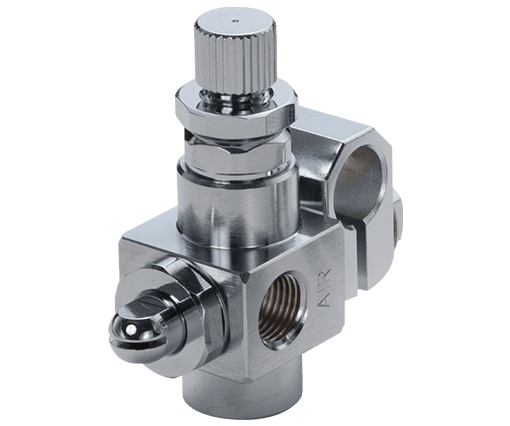
and for air been reversed? The inlet for liquid is marked
“LIQUID.” (The inlet for air is marked “AIR”
or “CYL,” which is the symbol for cylinder air
for piston operation.) Confirm that this is the case and correct
the connections in kind. |
| O-ring (Y-ring) damage |
| |
If needle O-rings or piston O-rings
are damaged, their greased parts broken off, and the needle
will not move, please make the appropriate replacements following
the procedure specified in the Instruction Manual. |
| A spray gun with specifications
for pressure feeding is being used without fluid pressure
applied |
| |
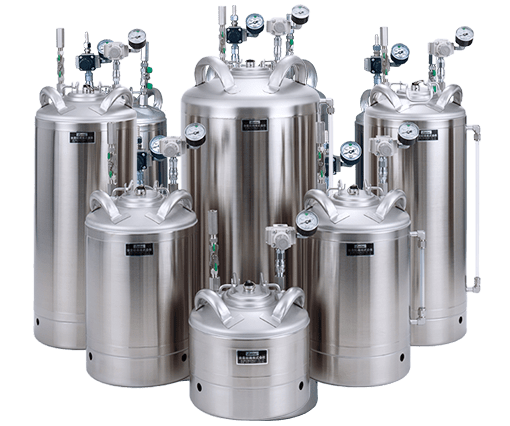
Spray guns to which fluid pressure
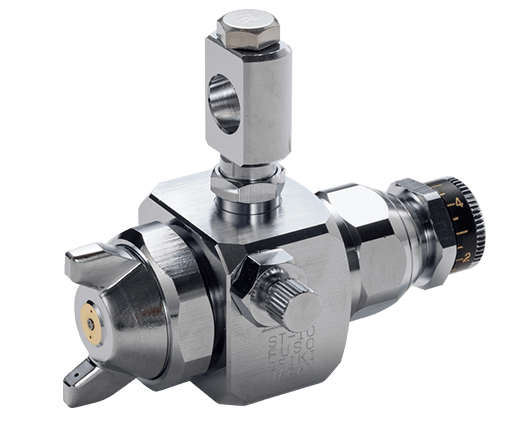
are applied, such as the ST-6PR, HM-1W and others, cannot
be used with gravity containers as pressure is insufficient.
Please use a pressure-feeding tank instead. |
|
 |
 |
 |
Liquid leaks from spray gun |
 |
| Nozzle and needle wear |
| |
If the spray gun has recently
been leaking liquid although it had been working fine before,
either nozzle and needle wear or dust, as explained next,
could be the problem.
Replace any damaged parts. Also, replace the nozzle and needle
together. (The fact that the nozzle is worn means that it
is highly likely that the needle is also worn.) |
| Dust or other foreign
matter has adhered to the end of the nozzle |
| |
Remove the nozzle and clean it.
When removing the nozzle, make sure to use the wrench that
has been specially made for this purpose (for the ST and PR
series). Use of a monkey wrench or pliers will damage the
nozzle, rendering it unusable. |
| Two-way solenoid valves
are being used for switching to piston air for models with
piston air separation (ST-6, PR-30, etc.) |
| |
Make sure to use three-way solenoid
valves for air for piston operation. |
|
 |
 |
 |
User suffers intermittent spraying |
 |
| Nozzle loosening |
| |
If the nozzle has loosened and
the part that connects to the main body is damaged, air will
penetrate the side for liquids, and the spraying will keep
being interrupted. Replace damaged parts. If the nozzle is
loose, use the wrench specially made for it to tighten it
firmly. |
| Needle O-ring damage |
| |
If the O-ring used on the part
of needle or piston valve that separates liquid and air is
damaged, air will penetrate the liquid side and intermittent
spraying could result. Replacing damaged O-rings will rectify
the problem. |
|
 |
 |
 |
Mist drifts upward |
 |
| |
This is not an actual defect,
but if mist drifts upward, it is because air pressure is high,
which enables the mist to be emitted strongly. In addition,
high air pressure will make mist particles finer. The fact
that mist itself is fine means that the finish of paint and
the like will be attractive, which in itself is certainly
not a bad thing.
However, coating efficiency will be reduced, and for such usage purposes as applying
press oil, mist will scatter around the entire workplace, deteriorating the work
environment.
To avoid this, please select a spray gun that is able to work
at low pressure: 0.1MPa or lower.
Possible candidates with systems that separate air for piston
operation include the ST-6 series, PR-30 and HM-6. In addition
to systems that separate air for piston operation, the ST-5P
and other models are equipped with a built-in mechanism for
achieving low-pressure atomization. |
|
 |
 |
 |
 |
|